
The struggle for representation of the Latine identity persists in the pursuit of inclusion in higher education.
BY JENNIFER OROZCO
As I walked the streets of the lively campus of the University of Wisconsin-Madison, I found myself captivated by the number of identities around me. Each person I passed carried their own unique story waiting to be told. However, with nearly 50,000 students, I found myself drawn to a smaller community often overlooked in an ocean of faces.
Only 7% of these students identify as Hispanic or Latino, and in this minority, there exists a story of resilience. Amidst immersing myself in this community, I engaged in conversation with incredible people.
I was introduced to the term, “Latine” (la-TEEN-eh). Quickly I realized that this term was more than a simple label for an ethnic group. This term reflected a past of adversity, an enriched culture, and a continued fight, all within the parameters of a college campus.
For a Latine, finding where you fit in at such a decentralized campus can be hard. Examining how best to represent a diverse group independently in a large institution is important. The Latine identity on campus has had to navigate through many hurdles and challenges to be what it is today. From advocacy for better programs to name changes, better representation has always been a conversation.

A mural in the Latine Cultural Center. Photo by Jennifer Orozco.
After years of picketing for academic recognition, the first Chican@ and Latin@ Studies (CLS), then known as the Chicano studies certificate, was issued in 1992. This certificate was the only one of its kind in ethics studies. The courses that followed were called “CHICLA” classes – a combination of the “chic” and “la” of Chican@ and Latin@.
Rachelle, a white Afro-Latine ‘09 alum and CLS advisor, recalls when there were only around 30 students in what was at the time a small CLS certificate.
“It’s a lack of mentorship and a lack of seeing yourself in the faculty. There’s this overwhelming white presence,” said Rachelle, “Where am I? Why are there no black and brown professors? Why do I see none? I think that in my CHICLA class, I finally saw that.”
For Rachelle learning in an environment where she felt represented made learning comfortable and made her feel seen.
“I saw that they were open, and some of them were queer, and they were just identifying in ways that I didn’t know you could as, a brown woman so strong and so educated,” Rachelle said. “When you have a brown professor, or I’m just thinking back to one of my professors, I felt comfortable sharing. She just made the room feel more welcome and more comfortable just by her presence alone.”

Rachelle is a UW-Madison ‘09 alum and Chican@ and Latino@ Studies advisor. Photo provided by Rachelle Eilers.
Now years later the program has grown and in 2023 it successfully became a major. However, the struggle for representation persists. Better funding for this program is needed to have staff representing what the students want to learn and to establish their department.
“I don’t really see Latine students on campus. I don’t really see them represented anywhere, except for my CLS classes,” said Kelly, a student, and Latine Heritage Month intern-chair.
Even within the Latine identity, catering to every sub-identity within this diverse group can be hard. “When you have an intersecting identity, you have to be mindful of the types of programming you do,” said Kelly. Both Rachelle and Kelly expressed the need for better funding to expand the possibilities for Latine students.
Kelly wants to cater events to intersecting identities within the Latine community. This includes but is not limited to Afro-Latines, Asian-Latines and more. These events will appropriately educate on the historical background of such identities but also make sure that no one is left out.

Kelly is a junior undergraduate student at UW-Madison and the Hispanic Heritage Chair Intern. Photo provided by Kelly Carranza.
“We all come in different shapes, colors, sizes, different countries that we hail from. And why are we pinning it against each other?” Rachelle said, “We should be building and hype each other up. We don’t need to be comparing and seeing who’s more Latine than the other.”
Staff face similar challenges with their own Latine identity. Natalie, the program coordinator for the Latine Cultural Center (LCC) identifies as mixed being Mexican – American, Filipina – American, Hispanic and white. Like intersectional students, she also experiences imposter syndrome.
Faculty and staff like Natalie, who can relate to and understand the challenges Latine students face, can help navigate the appropriate representation of the Latine community on campus.
The advocacy on campus helps better represent this community. The LCC started as a student activism group, it’s important to continue to honor that active student voice.
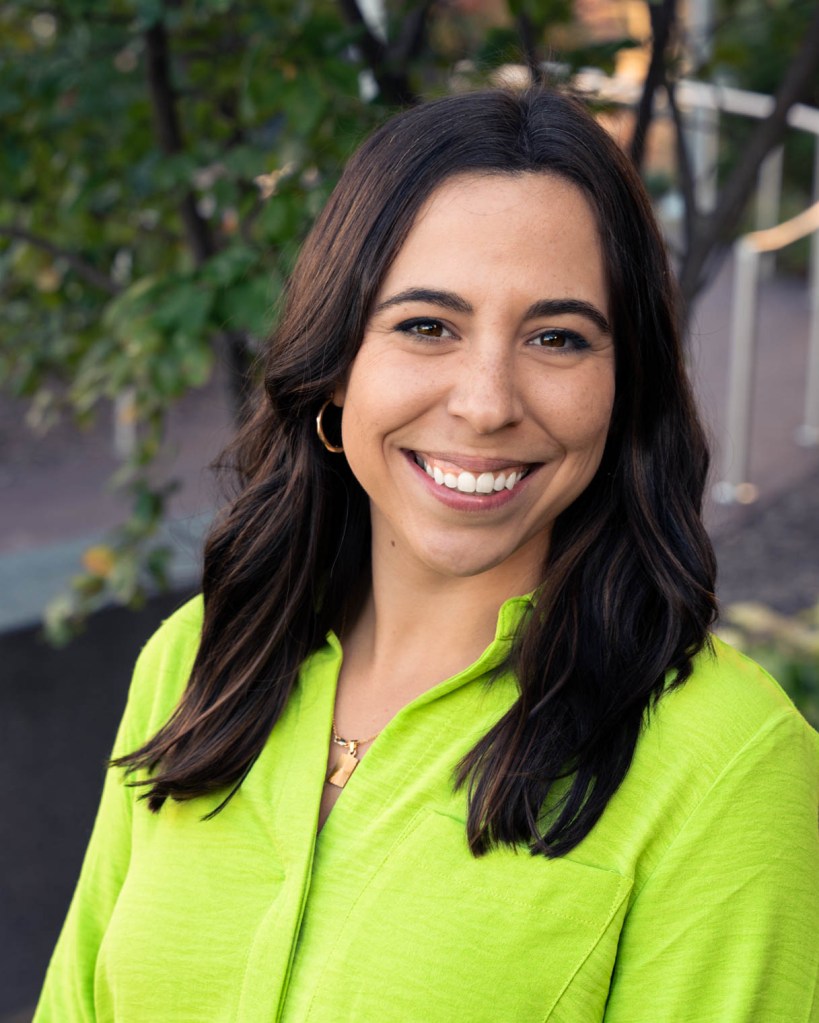
Natalie is the program coordinator for the Latine Cultural Center (LCC). Photo provided by Natalie Ergas.
“I have definitely seen activism through student ORGs, like MEChA,” said Natalie, “It’s definitely necessary, especially if you’re a student and you’re paying tuition, you should make sure that your voice is heard and represented.”
Since the LCC was established in 2018, it has strived to create a safe space where Latine students can find who they are in community.
Despite being a minority group on campus they refuse to be marginalized or silenced. Instead over time with determination and pride, they have embraced the Latine identity, carving out a space within the university.
Being Latine represents all intersecting identities of a person, the struggles, the accomplishments and the continued fight for representation. Furthermore, there is no accurate measure of someone’s Latinidad.
As you walk the streets of the University of Wisconsin–Madison, reflect on the power identity holds to shape your experience and connect you with something bigger than yourself. At this ever-growing university, stories like those of the Latine community foster a sense of belonging.
“Continued commitment to the student population,” Natalie said, “The student population is growing. And though it’s amazing that we have our current space, it is very likely that we’re going to need more space, we’re going to outgrow the space that we’re in.”
Cover photo by Jennie Clavel on Unsplash
For more information, visit my website on Latine identity at the University of Wisconsin at Madison.
 Jennifer's Portfolio